
A suspended tax loss on Form 8582 is not a “lost” deduction. When managed intentionally, passive losses become a valuable tax shield waiting to absorb the right type of future income.
When evaluating an investment in a pass-through entity, such as Containers, Farming, or Car Washes, taxpayers often focus heavily on securing current-year deductions. However, if an investment is intentionally structured as a passive capital allocation, or if an investor chooses not to log active co-management hours, the allocated losses are generally tracked on Form 8582 as suspended passive activity losses (PALs).
Results are fact-dependent and subject to the loss limitation rules (outside basis, at-risk, passive activity limits, and the excess business loss limitation), plus other federal and state tax considerations.
For high earners, managing suspended passive losses is a core component of long-term tax strategy.
1. The Tax Mechanics of Form 8582: Understanding the Income Buckets
Under IRC § 469, federal tax law categorizes income and losses into three distinct statutory “buckets”:
- Bucket 1: Nonpassive income (includes wages; and income from trades or businesses you materially participate in).
- Bucket 2: Portfolio income (generally interest, dividends, and most capital gains).
- Bucket 3: Passive activity income and loss (activities you don’t materially participate in; and many rental activities unless an exception applies).
The Core Rule of Form 8582: Passive losses can offset only passive income, subject to certain rental real estate allowances and other limited rules. Passive losses generally cannot offset nonpassive or portfolio income unless and until they are released (for example, under §469(g) on a qualifying disposition), and subject to the other limitation rules.
Disallowed passive losses generally carry forward under IRC § 469(b).
2. High Upfront Depreciation & Form 8582 Tracking
When an operating business utilizes accelerated depreciation under IRC § 168(k), first-year passive loss allocations can be substantial. These positions are fact-sensitive and documentation-driven, including whether taxpayers are improperly mixing income buckets.
Accurate tracking on Form 8582 ensures suspended PAL carryforwards remain defensible.
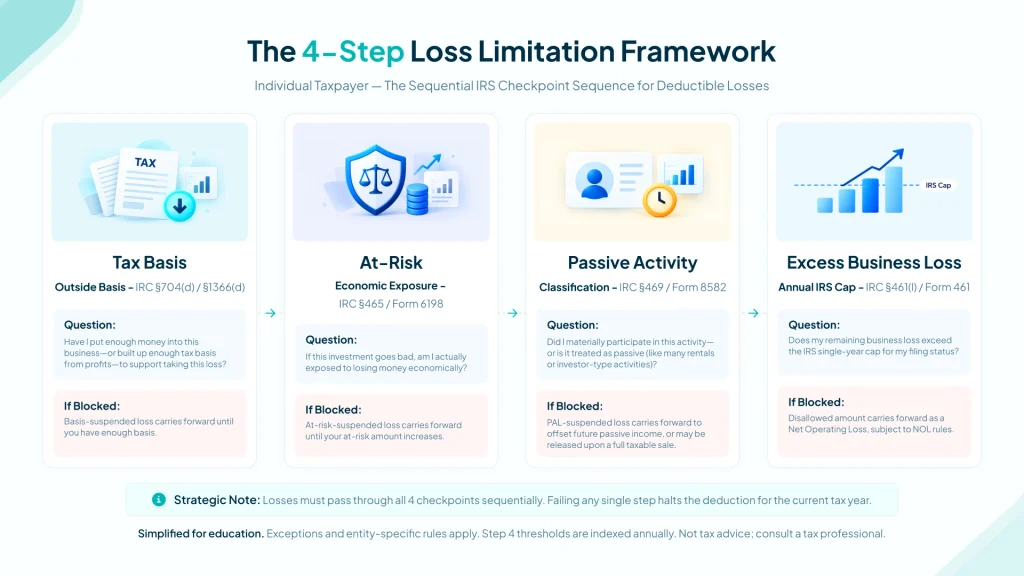
3. The 4-Step Loss Limitation Framework
Form 8582 operates specifically at Step 3:
- Step 1: Outside basis (§704(d)/§1366(d)).
- Step 2: At-risk (§465 / Form 6198).
- Step 3: Passive activity (§469 / Form 8582): Is the activity nonpassive (for example, because you materially participated), or is the loss passive and tracked on Form 8582? (This guide).
- Step 4: Excess business loss cap (§461(l) / Form 461).
Strategic Note: Because a §469-suspended loss is not currently deductible, it generally does not reduce taxable income in the year generated; §461(l) applies to the taxpayer’s deductible net business loss for the year (after other applicable limitations).
4. Strategic Trade-offs: The Impact of Your Choice on Your Outcome
Choosing whether to claim an immediate nonpassive deduction (Path A) or build a suspended passive loss carryforward (Path B) is an intentional portfolio decision. Consider our baseline scenario:
| Structural Dimension | Path A: Active Co-Management Choice | Path B: Passive Capital Allocation Choice |
|---|---|---|
| Operational Commitment | High: 100+ hours logged in qualifying co-management tasks. | If treated as a limited partner for §469 purposes, Test 3 is generally unavailable; participation may occur, but the activity is treated as passive unless an allowed material participation test is met. |
| Form 8582 Treatment | Generally not tracked on Form 8582: The activity is treated as nonpassive if an applicable material participation test is met (fact-dependent). | Flows to Form 8582: Loss is reported as a suspended passive activity loss (PAL). |
| Current Taxable Income Offset | A nonpassive loss may offset other nonpassive income to the extent deductible (then subject to Step 4, the excess business loss cap). | Often no current offset against wages unless you have passive income (and subject to the other limitation rules). |
| Multi-Year Asset Value | Illustrative current-year tax reduction: May provide current-year liquidity relief, depending on your marginal rate and the limitation rules. | Potential carryforward value: $400,000 PAL carryforward that may offset future passive income and/or be released on a qualifying disposition, to the extent allowed. |
This comparison focuses on Step 3 (passive vs. nonpassive). It does not change the requirement that losses are deductible only to the extent they first clear Step 1 (outside basis), Step 2 (at-risk), and Step 4 (excess business loss cap), and then any applicable §172 NOL rules.
5. Intentionally Pairing High-Yield Passive Income With Suspended PALs
In long-term tax planning, building a bank of suspended PALs on Form 8582 allows investors to shelter future passive cash flow.
The Matching Engine:
Accumulated Suspended PAL Carryforward (Form 8582) + Incoming High-Yield Passive Income = Potentially tax-sheltered net cash flow (reduced, and in some cases substantially reduced, federal income tax on that passive income, until PALs are absorbed).
Releasing Suspended Losses at Disposition (IRC § 469(g))
Under IRC § 469(g)(1), when a taxpayer disposes of their entire interest in a passive activity to an unrelated party in a fully taxable transaction, remaining suspended PALs attributable to that activity are released and may offset other income on the return (including nonpassive income) to the extent allowed.
6. Practical Application: Taxpayer Decision & CPA Due Diligence
For the Taxpayer: Evaluating Tax-Sheltered Yield
If you do not need an immediate W-2 tax offset, intentionally preserving a $400,000 PAL carryforward on Form 8582 allows you to deploy future capital into high-yield passive assets (such as Containers) and receive passive income that may be partially or fully offset by available suspended passive losses, to the extent allowed.
A secure document repository can help archive historical Form 8582 filings across multi-year holding periods.
For the CPA: Household-Level Income Bucket Matching
- K-1 Passive Loss Tracking: Track Schedule K-1 passive loss allocations across multiple activities to ensure separate accounting.
- Spousal Income Bucket Coordination: Coordinate household-level income buckets under IRC § 469.
- CAS Packaging: Multi-year passive income matching modeling might be combined in Client Advisory Services (CAS) retainers.