
Navigating individual statutory rules is necessary, but the real work is integrating them into a cohesive structure. Entity architecture determines how allocations, participation hours, and deductions flow across your entire portfolio.
Throughout this series, we have evaluated the individual statutory checkpoints that govern pass-through tax deductions, from outside basis and at-risk limits to passive activity rules and the excess business loss cap. However, treating these checkpoints as isolated annual hurdles creates friction and can be harder to support if examined.
High-earning investors and their advisory teams must look at entity architecture holistically. This final installment synthesizes the 4-Step Loss Limitation Waterfall into a unified structural strategy, examining how holding company design, grouping elections under the §469 regulations (generally Treas. Reg. §1.469-4), and spousal planning protect deductions from multi-year statutory barriers to help support a more audit-defensible tax position.
1. The Multi-Tiered Entity Architecture
A common structural model for high-earning investors participating in active commercial strategies involves a multi-tiered pass-through architecture:
Tier 0: Taxpayer / Household
Tier 1: Holding Entity (Often a Holding SMLLC)
- Central administrative hub for documents, time logs, and governance.
- May provide limited liability protection under state law.
Tier 2: Operating Partnerships / Assets
- Executes operations, incurs leverage, and generates depreciation allocations.
Why Structure Matters (Practical)
- Liability separation: Helps isolate operational risks under state law.
- Centralized recordkeeping: Creates a single hub for contracts, bank statements, and hours.
- Cleaner co-management documentation: Streamlines proof of active involvement across multiple deals.
2. Grouping Elections: When They Can Make Tracking Easier
When an investor participates in multiple operating partnerships or distinct commercial activities, logging hours separately for each activity can make meeting material participation thresholds challenging.
When Grouping Can Help
Under appropriate circumstances, taxpayers may be able to group certain activities into a single “appropriate economic unit” for §469 purposes, based on factors such as similarities in business types, extent of common control, common ownership, and geographic location.
What Grouping Changes (and What It Doesn’t)
By grouping qualifying activities into a single economic unit, participation hours across all grouped operations are combined. This can make it easier to meet an applicable material participation test across a multi-asset portfolio, depending on how the activities are grouped and how the interest is treated for §469 purposes.
Consistency/Disclosure Expectations
Once an aggregation election is made on a return, taxpayers generally must report results consistently in subsequent years unless a material change in facts occurs. Formal disclosure statements must accompany the tax return in the year of election.
Grouping can help for §469 purposes, but it does not override Step 1 (outside basis), Step 2 (at-risk), or Step 4 (excess business loss cap).
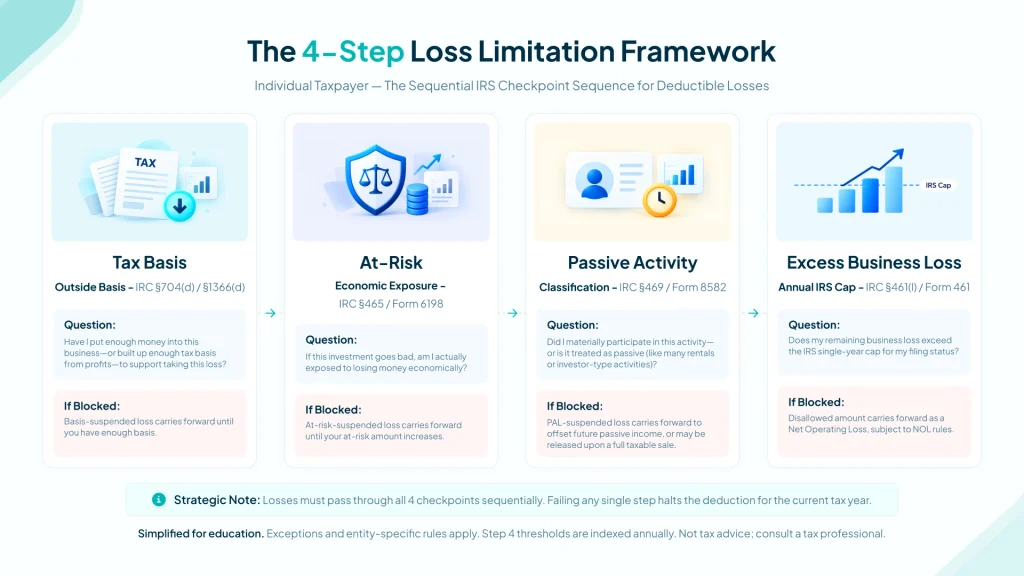
3. The Unified 4-Step “Can I Use This Loss?” Waterfall
To potentially use a loss against wages and other nonpassive income, it must clear all four statutory checkpoints sequentially without stopping at any gatekeeper:
- Step 1: Outside basis (§704(d)/§1366(d)). Do I have enough tax basis (including any liability basis, where applicable) to support this loss?
- Step 2: At-risk (§465 / Form 6198). Am I truly at risk for this debt (net of reimbursement or indemnity protections)?
- Step 3: Passive activity (§469 / Form 8582). Is the activity nonpassive (for example, because I materially participated)?
- Step 4: Excess business loss cap (§461(l) / Form 461). Does my total net business loss for the year fall within the annual inflation-adjusted §461(l) ceiling for my filing status?
Then: Carrying any excess forward under the NOL rules (generally §172), subject to the rules in effect for the carryforward year.
4. Strategic Trade-offs: Comparing Entity & Reporting Approaches
Designing a tax strategy involves evaluating choices between direct, unaggregated participation and a structured, aggregated holding model.
| Dimension | Direct / Ungrouped Model (Option A) | Structured / Grouped Model (Option B) |
|---|---|---|
| Entity Architecture | Direct Individual Ownership: Taxpayer holds K-1s directly in personal name. | Tiered Holding Structure: Holding SMLLC owns partnership interests; isolates liability under state law. |
| Participation Tracking | Isolated Activity Hours: Hours logged separately for each K-1 allocation. | Grouped Economic Units: Hours combined across qualifying activities under Treas. Reg. § 1.469-4. |
| Material Participation Reach | Higher hour bar: You may need to meet an applicable test separately for each activity. | Streamlined hour tracking: Grouping may allow hours to be combined for the grouped unit, depending on the facts and the grouping. |
| Audit Preparedness | Fragmented Records: Time logs and contracts scattered across multiple investments. | Centralized Dossier: Unified time logs, operating agreements, and resolutions in a single repository. |
| Administrative Flexibility | Rigid: Limited ability to offset hours or streamline multi-asset operations. | Requires Election Discipline: Grouping elections generally require consistency and may require disclosure; changes are typically limited unless facts materially change. |
Deductions remain subject to clearing Steps 1–4, and then any applicable §172 NOL rules.
5. Multi-Year Planning & Spousal Participation Rules
Spousal Participation Rule
In determining whether a taxpayer materially participates in an activity, participation by their spouse is treated as participation by the taxpayer, regardless of whether you file jointly or whether the spouse holds a direct ownership interest in the entity.
Multi-Year Pacing
Utilizing multi-year EBL modeling allows high earners to pace active losses across different tax years, matching deductions with liquidity events (e.g., business sales, option exercises, or high-earning W-2 years) while building structured NOL carryforwards for future tax relief.
6. Practical Application: Execution & CPA Due Diligence
For the Taxpayer: Maintaining the Operational Dossier
Substance and documentation drive tax outcomes. Taxpayers should maintain near-contemporaneous time logs (recording specific co-management tasks, dates, and durations), archive fully executed promissory notes and operating agreements, and store grouping election statements in a secure document repository.
For the CPA: Multi-Tiered Return Coordination
- Operating Agreement Analysis: Evaluate governing operating agreements to confirm explicit co-management rights.
- Grouping Disclosures: Prepare and attach formal grouping disclosure election statements with the tax return under Treas. Reg. § 1.469-4.
- Multi-Year Loss Tracking: Coordinate and track suspended loss carryforward schedules across Forms 6198, 8582, and 461.
- Integrated Structural Advisory: Structural oversight across the taxpayer’s multi-tiered architecture might be combined in Client Advisory Services (CAS) engagements.
Bottom line: structure and recordkeeping can help, but the tax benefit is realized only to the extent losses clear Steps 1–4, and then any applicable §172 NOL rules.