
A $100,000 cash investment in a leveraged private placement can allocate tax losses far larger than your initial contribution. Whether those losses actually reduce your taxable income depends on a few practical checkpoints, starting with (1) whether you have enough tax basis and (2) whether you’re actually at risk for the debt.
When evaluating an investment in an operating partnership, such as Farming, Car Washes, or Containers, investors often anticipate that debt-financed leverage will generate significant first-year depreciation deductions to lower their overall taxable income. However, if those debt arrangements and underlying agreements are not structured to satisfy specific statutory requirements, the allocated losses may be suspended at the partner level, regardless of your participation level under the passive activity rules.
Understanding how partnership debt affects your tax basis and what you could actually lose is essential for high-earning taxpayers and their advisory teams. This guide assumes you’re aiming for nonpassive treatment; the focus here is the two gatekeepers that often stop a loss before the passive-loss rules even matter: your tax basis and your at-risk amount.
Debt can increase your tax basis in a partnership without increasing what you’re actually at risk for, so a loss that looks deductible on paper may still be suspended. Results are fact-dependent and subject to the loss limitation rules (outside basis, at-risk, passive activity limits, and the excess business loss limitation), plus other federal and state tax considerations.
1. What Are “Outside Basis” and the At-Risk Rules?
For an individual partner, claiming a pass-through loss requires allowable checkpoints before passive activity loss rules or business loss caps even apply:
Step 1: Tax Basis (Outside Basis)
Outside basis generally starts with cash contributed, then moves up or down for income, losses, distributions, and (in many cases) your share of partnership liabilities. A liability allocation can increase outside basis without increasing your at-risk amount, so the two numbers often diverge in leveraged deals.
Step 2: At-Risk Amount (Real Economic Exposure)
You’re generally at risk for cash you put in and for certain debt where you’re truly on the hook, reduced by any protections that shift the risk away (for example, reimbursement rights or indemnities).
Whether a borrowing increases your at-risk amount is fact-dependent and can be reduced or eliminated by loss-protection arrangements.
Key Takeaway: In leveraged deals, it’s common to have enough tax basis to be allocated a loss, but not enough at-risk amount to deduct it currently. In that case, the excess is typically suspended under the at-risk rules and carried forward.
2. High Upfront Depreciation & Audit Preparedness
When an operating business uses accelerated depreciation (including bonus depreciation, where available), the resulting first-year tax losses can be substantial. If the activity is nonpassive, those deductions may offset other nonpassive income (including wages) to the extent the loss is otherwise deductible under the basis, at-risk, and return-level limits.
Because large write-offs reduce taxable income substantially, these positions are fact-sensitive and documentation-driven, making good documentation especially important.
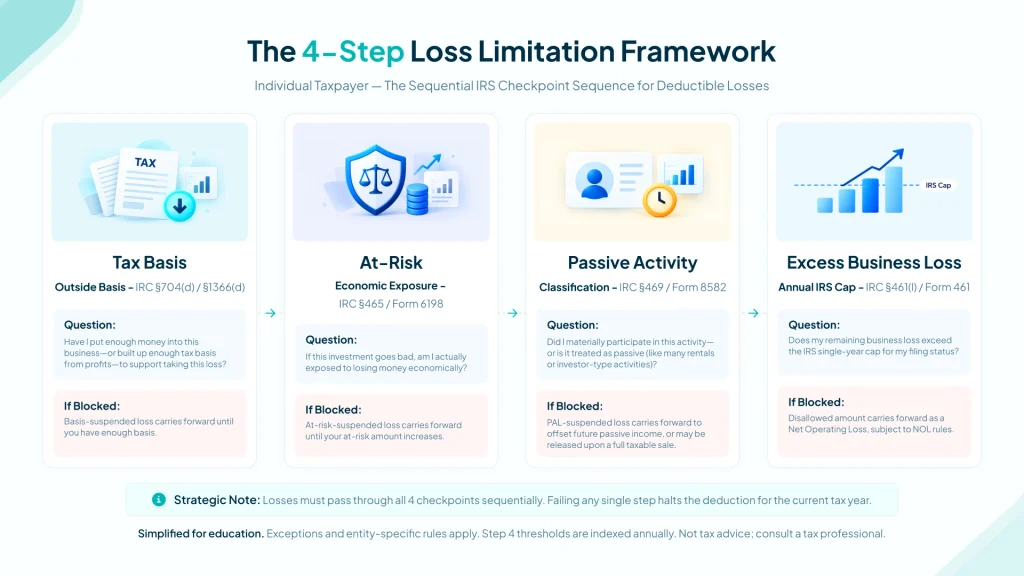
3. The 4-Step Loss Limitation Framework
A practical framework for evaluating pass-through losses requires navigating four sequential checkpoints:
Step 1: Outside Basis (§704(d)/§1366(d))
Core Question: “Do I have enough outside basis (tax basis) to support this loss?”
If blocked: The loss is generally suspended and carried forward until you have enough basis.
Step 2: At-Risk (§465 / Form 6198)
Core Question: “Do you have a sufficient at-risk amount, net of loss-protection arrangements?”
If blocked: The loss is generally suspended until you have more at-risk amount (or the activity generates income).
Step 3: Passive Activity (§469 / Form 8582)
Core Question: “Is the activity nonpassive (for example, because you materially participated)?”
If blocked: The loss is generally suspended as a passive loss and carried forward.
Step 4: Excess Business Loss Cap (§461(l) / Form 461)
Core Question: “Does my total net business loss for the year fall within the annual inflation-adjusted §461(l) ceiling for my filing status?”
If blocked: The disallowed excess is generally carried forward as part of your NOL, subject to the rules in effect for the carryforward year.
4. Strategic Trade-offs: The Impact of Your Choice on Your Outcome
Using debt to fund operations requires balancing tax optimization against real economic risk. Consider our baseline scenario:
Capital Allocation: $100,000 out-of-pocket cash capital placed into a potentially eligible commercial asset utilizing a $300,000 liability allocation that (together with cash) may support up to $400,000 of allocated deductions, subject to the loss limitation rules.
| Structural Dimension | Option A: Personal Recourse Debt Choice | Option B: Standard Nonrecourse Debt Choice |
|---|---|---|
| Step 1: Outside Basis (IRC § 704(d)) | $400,000 Outside Basis: Cash ($100,000) + illustrative share of partnership liabilities ($300,000), as determined under the partnership liability allocation rules. | $400,000 Outside Basis: Cash ($100,000) + illustrative share of partnership liabilities ($300,000), as determined under the partnership liability allocation rules. |
| Step 2: At-Risk Amount (IRC § 465) | Up to $400,000 at risk (illustrative; fact-dependent): Taxpayer may bear economic risk of loss to the extent the taxpayer is economically exposed to loss under the debt terms (and not protected by reimbursement or similar arrangements). | Often $100,000 at risk (illustrative; fact-dependent): Commonly limited to cash contributed where the debt does not create partner-level economic risk of loss. |
| Economic Liability Exposure | Higher Exposure: Lenders may seek recovery from personal assets if partnership cash flows default. | Generally lower exposure: Economic exposure is typically limited to cash invested absent guarantees or other loss-sharing arrangements. |
| Current Taxable Income Offset | A loss may be deductible up to the amount supported by basis and at-risk amount (and then subject to the passive-loss rules and the annual loss cap). | Illustrative: If only $100,000 is at risk, the excess (e.g., $300,000) is generally suspended and carried forward under the at-risk rules. |
| Illustrative Cash Tax Impact | Illustrative current-year tax reduction: May reduce current-year taxable income to the extent the loss is deductible and based on year-specific rates. | Deferred Value: $300,000 at-risk carryforward (illustrative). |
Results are fact-dependent and subject to the loss limitation rules (outside basis, at-risk, passive activity limits, and the excess business loss limitation), plus other federal and state tax considerations.
This illustration is intended to show how leverage can affect Step 1 (outside basis) and Step 2 (at-risk). It does not change the requirement that a loss is deductible only to the extent it clears Steps 1–4, and then any applicable NOL rules.
5. Real Estate vs. Equipment-Heavy Investments (Section 1245 Property)
Some real-estate financing can count as “at risk” even if it’s nonrecourse, but that exception is narrow. Commercial activities centered on personal property or equipment (IRC § 1245 property), such as car wash equipment, agricultural machinery, or container fleets, often cannot rely on qualified nonrecourse financing rules.
In many equipment-heavy structures, nonrecourse debt may not increase an investor’s at-risk amount above cash and other qualifying at-risk amounts, meaning excess debt-allocated losses are at-risk suspended under IRC § 465.
6. Evaluating Audit-Defensible Recourse Notes
A recourse structure that’s more audit-defensible requires meeting three criteria:
- Unconditioned Economic Risk of Loss: The partner must be the obligor of last resort under Treas. Reg. § 1.752-2 and IRC § 465 without reimbursement rights.
- Substance Over Form in Guarantees: A guarantee alone may not be enough, especially if there are reimbursement/indemnity provisions, hidden hold-harmless clauses, or the lender cannot realistically enforce it.
- Third-Party Financing Independence: Borrowings from related parties or non-creditor equity participants do not increase at-risk basis under IRC § 465(b)(3).
7. Practical Application: Taxpayer Decision & CPA Due Diligence
For the Taxpayer: Risk vs. Reward
On a $100,000 cash placement, assuming $300,000 in recourse debt expands total economic exposure to $400,000. Taxpayers should evaluate whether the potential tax benefit justifies assuming personal liability based on asset quality and insurance coverage. Executed notes and bank transfers should be archived in a secure document repository.
For the CPA: Due Diligence Beyond Schedule K-1
- Operating Agreement Review: Evaluate operating agreements to verify no hold-harmless provisions exist.
- Promissory Note Verification: Confirm promissory note independence.
- Advisory Engagement Packaging: Due diligence might be combined in Client Advisory Services (CAS) engagements.