A $100,000 tax loss does not automatically reduce your taxable income by $100,000. Your actual involvement determines the loss’s classification.
You might invest in an operating business or private placement, such as Farming, Car Washes, or Containers, expecting significant depreciation deductions to lower your tax bill. However, when you hand your Form K-1 to your CPA, they may explain that the loss is “passive,” preventing you from using it to offset other nonpassive income (including wages) on your return that year.
For high earners, this distinction changes the entire mathematical value of an investment. Results are fact-dependent and subject to the loss limitation rules (outside basis, at-risk, passive activity limits, and the excess business loss limitation), plus other federal and state tax considerations.
Whether you are evaluating a new opportunity or reviewing an existing portfolio, material participation is often a key fact in supporting nonpassive treatment under §469, and it should be documented in an audit-defensible way. This guide explains how to identify the applicable participation test, maintain audit-defensible records, and evaluate how participation fits alongside other statutory deduction limits.
1. What Is Material Participation?
Material participation determines whether your involvement in an activity is sufficient under the federal passive activity loss rules of Internal Revenue Code (IRC) § 469.
Ownership alone is insufficient to claim an active tax loss. Investing capital, holding a title, or attending annual investor updates does not satisfy the IRS. If you materially participate in a trade or business, the activity’s income or loss is generally nonpassive, which may allow the loss to offset other nonpassive income on your return (including wages), to the extent the loss is otherwise deductible under the outside basis, at-risk, and other limitations.
If you do not materially participate, the losses are classified as passive and are typically suspended on Form 8582 until you have passive income and/or a qualifying disposition event under §469(g), subject to the other limitation rules.
2. High Upfront Depreciation & Audit Preparedness
When an operating business or partnership utilizes accelerated or first-year depreciation under IRC § 168(k), the resulting first-year tax losses allocated via Schedule K-1 can be substantial. If the activity is treated as nonpassive, those deductions may offset other nonpassive income on your return to the extent otherwise deductible, creating potential cash-flow timing advantages.
However, because large first-year write-offs can reduce taxable income substantially, these positions are fact-sensitive and documentation-driven. Material participation alone does not make a loss currently deductible; the loss is deductible only to the extent it clears Step 1 (outside basis) and Step 2 (at-risk) first, and it may still be limited at the return level (including Step 4). This makes well-supported, near-contemporaneous documentation one of the most audit-defensible approaches.
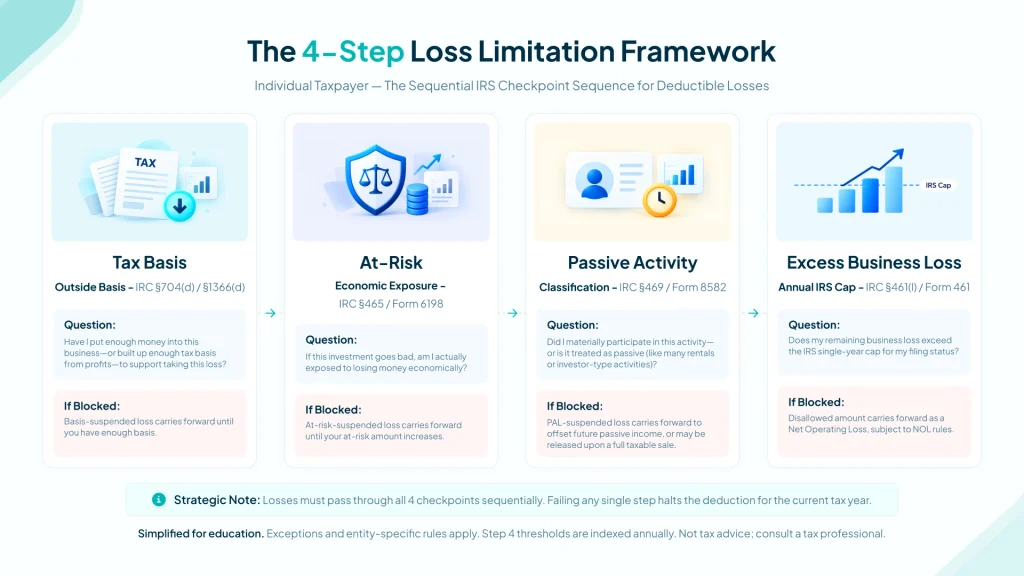
3. The 4-Step Deduction Limitation Waterfall
Material participation is a vital step, but it does not operate in a vacuum. To safely claim an investment deduction, your CPA will typically guide you through four sequential IRS checkpoints. If any step limits the loss, the limited amount is generally suspended or carried forward under that step’s rules, regardless of how well the other steps are satisfied:
Step 1: Outside Basis (§704(d)/§1366(d))
Core Question: Does your adjusted tax investment support the allocated loss?
Step 2: At-Risk (§465 / Form 6198)
Core Question: Do you have a sufficient at-risk amount (cash invested and any other qualifying at-risk exposure), net of loss-protection arrangements?
Step 3: Passive Activity (§469 / Form 8582)
Core Question: Is the activity nonpassive (for example, because you materially participated)?
Step 4: Excess Business Loss Cap (§461(l) / Form 461)
Core Question: Does your total net business loss for the year fall within the annual inflation-adjusted §461(l) ceiling for your filing status?
4. Strategic Trade-offs: The Impact of Your Choice on Your Outcome
To see how material participation directly controls your net cash flow, consider our baseline scenario:
- Taxpayer Profile: U.S. Citizen, Married Filing Jointly (MFJ) operating in a top marginal tax bracket.
- Capital Allocation: $100,000 out-of-pocket cash capital in a potentially eligible commercial asset with leverage/liability allocations that (together with cash) may support up to $400,000 of allocated deductions for outside-basis purposes, subject to the loss limitation rules.
Assuming the investment is to the extent supported by outside basis and at-risk amount (net of loss-protection arrangements), here is how active log execution changes the immediate outcome:
| Structural Dimension | Path A: Active Co-Management Choice | Path B: Passive Capital Allocation Choice |
|---|---|---|
| Operational Commitment | High: 100+ hours logged in qualifying co-management tasks (e.g., vendor negotiations, budget approvals). | If treated as a limited partner for §469 purposes, Test 3 is generally unavailable; participation may occur, but the activity is treated as passive unless an allowed material participation test is met. |
| Legal & Entity Profile | Active Role: Requires active co-management authority (e.g., General Partner or Active LLC Member status). | Passive Role: Limited Partner (LP) style structure; capped operational liability. |
| IRC § 469 Classification | Nonpassive loss: May be treated as nonpassive if an applicable material participation test is met (often Test 3 in co-management structures, if available), then subject to other limitations (including Steps 1, 2, and 4). | Passive Loss: Flows to Form 8582 as a suspended passive activity loss (PAL) carryforward. |
| Current Taxable Income Offset | A nonpassive loss may be usable against other nonpassive income to the extent deductible (then subject to §461(l) and other return-level limits). | Generally $0 current offset against nonpassive/W-2 income (absent passive activity income); loss preserved on Form 8582. |
| Illustrative Cash Tax Impact | Illustrative current-year tax reduction: May allow current-year use of a deduction, subject to the loss limitation rules (Steps 1–4) and year-specific rates. | Preserved Value: $400,000 PAL carryforward to shield future passive yield or gain on disposition. |
Results are fact-dependent and subject to the loss limitation rules (outside basis, at-risk, passive activity limits, and the excess business loss limitation), plus other federal and state tax considerations.
This illustration is intended to quantify the time/effort trade-off; it does not change the requirement that a loss is deductible only to the extent it clears Step 1 (outside basis), Step 2 (at-risk), Step 3 (passive activity rules), and Step 4 (excess business loss cap), and then any applicable §172 NOL rules.
5. The 7 Material Participation Tests & the Investor Capacity Rule
Under Treasury Regulation § 1.469-5T(a), a taxpayer qualifies as materially participating if they meet at least one of seven statutory tests during the tax year:
- Test 1 (500+ Hours): You participate for more than 500 hours during the tax year.
- Test 2 (Substantially All Work): Your participation constitutes substantially all work performed.
- Test 3 (100+ Hours & Most Time Spent): You participate for more than 100 hours, and no other individual participates more.
- Test 4 (Significant Participation Activities): Aggregated participation across SPAs exceeds 500 hours.
- Test 5 (5 of Prior 10 Years): Material participation in 5 of the preceding 10 tax years.
- Test 6 (Personal Service Activity): Material participation in 3 preceding tax years for service activities.
- Test 7 (Facts & Circumstances): Regular, continuous, and substantial participation (subject to regulatory limitations, including a 100-hour minimum and restrictions when others are compensated to manage the activity).
Critical Distinction: Disqualified Investor Hours vs. Active Work
Under Treas. Reg. § 1.469-5T(f)(2), hours spent reviewing financial statements, reading sponsor reports, or monitoring operations in an investor capacity generally do not count toward any test. Qualifying hours require active co-management duties, such as direct vendor negotiations, budget approvals, and contract executions.
Furthermore, if treated as a limited partner for §469 purposes, the regulations generally restrict the taxpayer to Tests 1, 5, and 6. An LLC member can be treated as a limited partner depending on rights; title alone isn’t determinative.
6. Contemporaneous Audit Trails: Evidence & Logging
If the IRS challenges your return, Treas. Reg. § 1.469-5T(f)(4) allows participation to be proven through “reasonable means”. However, courts have often rejected post-event estimates or reconstructed spreadsheets created years later based on the facts and records.
Maintaining near-contemporaneous records (calendar entries, emails, task notes, meeting minutes, and supporting documents) is often the most audit-defensible approach.
7. Practical Application: Taxpayer Decision & CPA Due Diligence
For the Taxpayer: Is the Strategy Worth the Effort?
Before entering an active co-management tax strategy, evaluate the real-world time commitment against projected tax relief:
- What Is Your Time and Risk Budget? In many active co-management strategies, the “return” is primarily timing, moving a large depreciation-driven loss into the current year by qualifying for nonpassive treatment. Whether that trade is worthwhile depends on (i) the size of the projected loss that is to the extent supported by outside basis and at-risk amount (net of loss-protection arrangements), (ii) your marginal tax profile, and (iii) the real-world cost of taking on co-management duties and related legal exposure.
- Leveraging Spousal Hour Stacking: Under IRC § 469(h)(5), participation by your spouse counts as your participation, allowing households to share operational management to fulfill Test 3.
- Capturing Records With Technology: Avoid manual spreadsheets. Using a dedicated compliance tool (for example, a secure portal/workflow system) can help with real-time task logging and document archiving from a smartphone.
For the CPA: Fulfilling Due Diligence Beyond the Form K-1
In practice, CPAs typically should not rely solely on the K-1 presentation when a client is using pass-through losses to offset significant nonpassive income:
- Operating Agreement Review: Analyze governing agreements to confirm the investor holds explicit, contractual co-management rights rather than passive LP status.
- Promissory Note & Side Letter Verification: Confirm that recourse notes contain no hidden indemnification clauses that eliminate economic risk.
- Packaging CAS Engagements: Due diligence might be combined in Client Advisory Services (CAS) retainers for agreement reviews and log verification.