
Navigating a tax strategy isn’t just about logging hours; it begins with having real management rights, not just good intentions. Your rights under the operating agreement can determine which “material participation” paths are even available.
When evaluating an active co-management investment, you might plan to meet the 100-hour material participation test (Test 3). However, if underlying legal documents classify you strictly as a Limited Partner (LP), you may find the activity is treated as passive for tax purposes even if you logged time.
Under federal tax regulations, a taxpayer’s legal role in an entity directly restricts their available tax options. This guide explains the practical tax impact of being treated as a managing partner vs. a limited partner under the passive activity rules (the detailed rules are in Treas. Reg. §1.469-5T(e)).
1. The Key Issue: Are You Treated Like a Limited Partner for Tax Purposes?
To treat a business loss as nonpassive (so it may offset wages and other active income), you generally need to materially participate. However, entity classification affects test eligibility:
- Managing-partner-style rights: You may be able to use any of the seven material participation tests (depending on facts).
- If treated as a limited partner for §469 purposes, the regulations generally restrict the taxpayer to Tests 1, 5, and 6.
- An LLC member can be treated as a limited partner depending on rights; title alone isn’t determinative.
In plain English: some of the most common “I helped manage” tests may be off the table.
2. Paperwork Matters More When the First-Year Loss Is Large
When an operating partnership allocates substantial first-year depreciation (including bonus depreciation, where available), these positions are fact-sensitive and documentation-driven.
If the agreement reflects LP treatment and lacks co-management rights, the activity may be treated as passive at Step 3, even if you spent time, because the time may not count under the limited-partner rules.
3. The 4-Step Loss Limitation Framework
This post is about Step 3 (passive vs. nonpassive). Steps 1, 2, and 4 still limit how much loss you can use:
- Step 1: Outside basis (§704(d)/§1366(d)).
- Step 2: At-risk (§465 / Form 6198).
- Step 3: Passive activity (§469 / Form 8582): Are the material participation tests you’re relying on available based on how your interest is treated?
- Step 4: Excess business loss cap (§461(l) / Form 461).
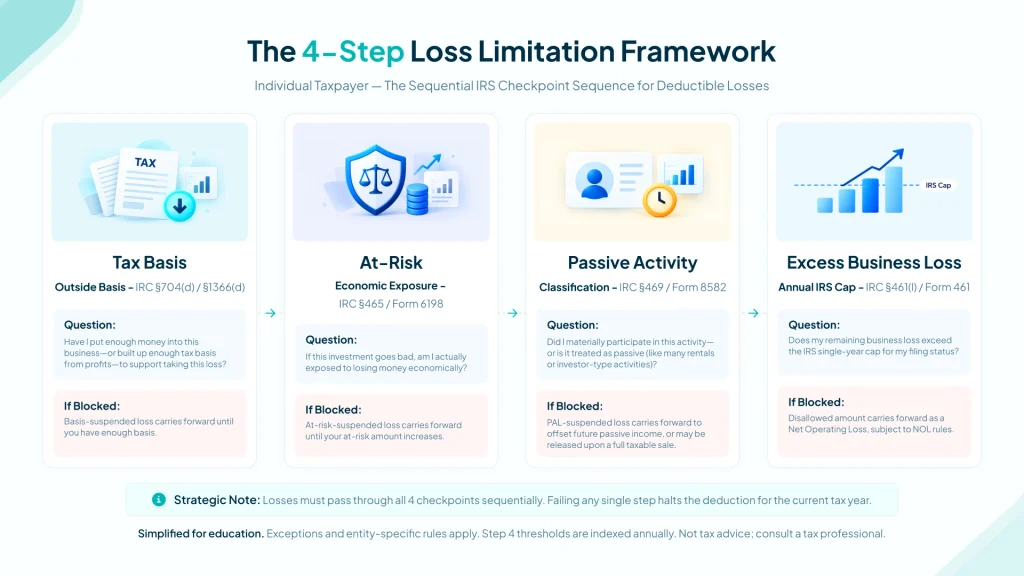
4. Strategic Trade-offs: The Impact of Your Choice on Your Outcome
Structuring an investment position as an active GP/Co-Manager versus a passive LP involves an intentional trade-off between potential current-year tax benefit and operational legal risk.
| Structural Dimension | Option A: Active Co-Manager / GP Choice | Option B: Passive Limited Partner (LP) Choice |
|---|---|---|
| Legal Entity Title | General Partner / Active LLC Member: Granted explicit contractual co-management authority. | Limited Partner: Capped legal liability; restricted from daily management. |
| Which “material participation” paths are available? | Unrestricted: May allow Test 3 (100+ hours), depending on facts and applicable limitations. | Restricted: Test 3 is generally unavailable; you’re generally limited to Tests 1, 5, or 6, so in many cases the practical bar is much higher. |
| Current Taxable Income Offset | May be treated as nonpassive if an applicable material participation test is met (fact-dependent), then subject to the other loss limits. | Often no current offset against wages unless you have passive income (or later trigger a release event), and subject to the other limits. |
| Legal Liability Exposure | Generally higher exposure: Active management rights and recourse debt can increase legal responsibility. | Generally lower exposure: Passive roles limit operational responsibility. |
This comparison focuses on Step 3 (passive vs. nonpassive). It does not change the requirement that a loss is deductible only to the extent it clears Steps 1–4, and then any applicable NOL rules.
5. The Year 1 GP-to-LP Structural Shift Idea
To balance upfront tax advantages against long-term legal exposure, some advisory teams consider a Year 1 GP-to-LP Structural Shift:
- Year 1 (Active GP Status): The investor enters as an active GP/Managing LLC Member, logging sufficient qualifying hours to support nonpassive treatment (often by relying on Test 3 where available) for Year 1.
- Year 2+ (Transition to LP): After the initial, front-loaded depreciation allocations are realized, the investor transitions to a passive LP class to cap ongoing legal liability and reduce the need to meet high annual hour thresholds in later years.
6. Executing Defensible Co-Management Agreements
An active entity structure is more audit-defensible when it includes three contractual elements:
- Explicit Operating Agreement Rights: Voting power over capital expenditures, vendor selection, and budget approvals.
- Execution of Resolutions: Real-time documentation of partner decisions and meeting minutes.
- Avoiding “paper manager” risk: Confirm the agreement doesn’t re-delegate day-to-day authority away from the purported managing partner/member.
7. Practical Application: Taxpayer Evaluation & CPA Due Diligence
For the Taxpayer: Evaluating Risk & Spousal Stacking
Stepping into an active co-management role requires balancing time commitments and liability against tax relief. Under IRC § 469(h)(5), hours worked by your spouse count toward Test 3. Archiving operating agreements and time logs in a secure document repository helps ensure records are ready if examined.
For the CPA: Cross-Disciplinary Coordination
- Limited-Partner Rule Analysis: Review agreements to understand whether limited-partner rules apply.
- Entity Structuring Coordination: Coordinate with legal counsel on entity architecture (such as whether a holding SMLLC is appropriate).
- Insurance Verification: Confirm commercial umbrella liability insurance is active and sufficient.