
A large trade or business loss can be a meaningful current-year tax reduction tool, subject to multiple limitations. But if your total net business losses exceed the annual ceiling, part of that deduction will be capped and pushed into future tax years.
When evaluating an active pass-through strategy, such as Farming, you might take the right steps to support outside basis and at-risk (Steps 1–2) and nonpassive treatment (Step 3). However, when your return is compiled, you may still find that a portion of your loss cannot be deducted in the current tax year.
Results are fact-dependent and subject to the loss limitation rules (outside basis, at-risk, passive activity limits, and the excess business loss limitation), plus other federal and state tax considerations.
For high earners, this barrier is known as the Excess Business Loss (EBL) limitation under Internal Revenue Code (IRC) § 461(l).
1. What Is the Excess Business Loss (EBL) Limitation?
The Excess Business Loss rule under IRC § 461(l) restricts the aggregate amount of net trade or business losses that noncorporate taxpayers (individuals, estates, and trusts) can use to offset non-business income, such as W-2 salary, pensions, dividends, or capital gains, in a single tax year.
- Business Loss Aggregation: To determine if an EBL exists, you must combine all gross income and allowable deductions across all of your active trades or businesses.
- The Annual Ceiling: If your total net business loss for the year exceeds the annual inflation-adjusted threshold for your filing status, the excess amount is disallowed for the current tax year.
Unlike the passive-loss rules (which can suspend losses activity-by-activity), the EBL cap is applied at the overall return level. It functions as an annual, return-level cap on how much active business paper loss can reduce non-business taxable income in any single year.
2. High Upfront Depreciation & State Tax Decoupling
When an operating business utilizes accelerated depreciation under IRC § 168(k), first-year losses can easily cross annual EBL limits. Form 461 is where the EBL cap is computed, and it often becomes relevant in high-depreciation years.
Furthermore, state tax decoupling can create unexpected state tax liabilities even when federal income is fully offset (for example, when a state disallows federal bonus depreciation).
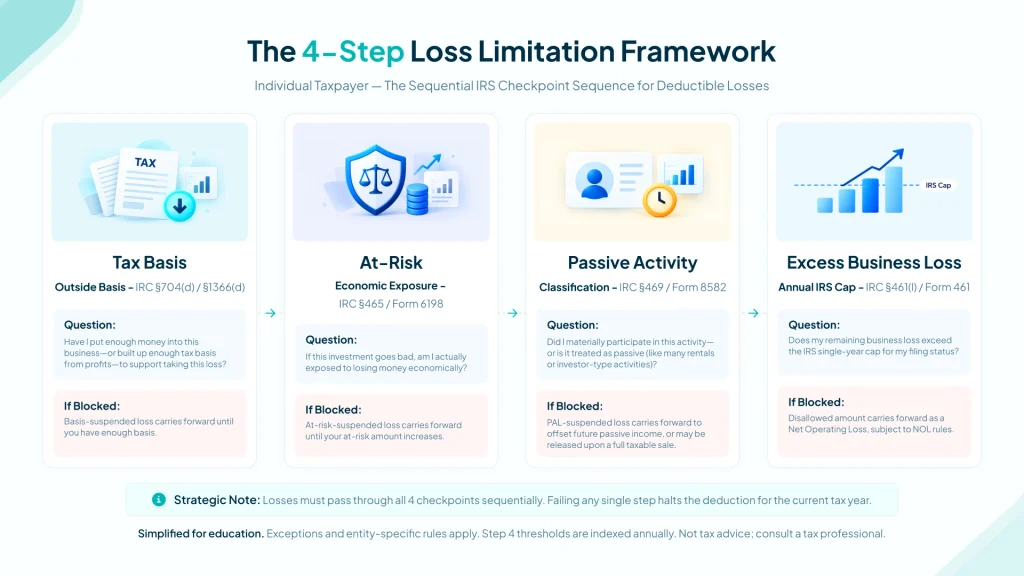
3. The 4-Step Loss Limitation Framework
The EBL limitation represents the final statutory hurdle in the sequential loss allowance sequence. After a loss is allowable at Step 1, Step 2, and Step 3 only to the extent the applicable requirements are met (yielding a nonpassive loss), Step 4 then determines how much of that business loss is deductible in the current year.
- Step 1: Outside basis (§704(d)/§1366(d)).
- Step 2: At-risk (§465 / Form 6198).
- Step 3: Passive activity (§469 / Form 8582).
- Step 4: Excess business loss cap (§461(l) / Form 461): Does your total net business loss for the year fall within the annual inflation-adjusted §461(l) ceiling for your filing status? (This guide).
4. Strategic Trade-offs: The Impact of Your Choice on Your Outcome
To see how the EBL cap interacts with a tax return, consider our baseline scenario. Assuming the investment(s) are allowable at Step 1, Step 2, and Step 3 only to the extent the applicable requirements are met (yielding nonpassive losses), here is how scaling total losses from $400,000 to $600,000 changes the result:
| Structural Dimension | Path A: Single-Placement Scenario ($400k Net Business Loss) | Path B: Scaled Multi-Placement Scenario ($600k Net Business Loss) |
|---|---|---|
| Total net business loss (for the year) | $400,000: Single $100k cash / $400k deduction allocation. | $600,000: Multiple active placements across commercial strategies. |
| IRC § 461(l) EBL Cap (Illustrative Threshold) | Under Cap: Total net business loss ($400,000) is fully within the statutory MFJ annual ceiling. | Cap Triggered: Total net business loss ($600,000) exceeds the statutory MFJ annual ceiling. |
| Current Taxable Income Offset | $400,000 fully deductible: Directly offsets W-2 / non-business taxable income. | Allowed up to the annual inflation-adjusted EBL threshold for the year (illustrated here as $512,000 for 2026 MFJ).* |
| Disallowed Loss Treatment | $0 Disallowed: No excess loss generated. | Illustrative disallowed excess: $88,000 ($600,000 − $512,000), treated as part of your NOL and generally carried forward under § 172, subject to the rules in effect for the carryforward year.* |
| Illustrative Cash Tax Impact | Illustrative current-year tax reduction: $400,000 reduces current-year taxable income, to the extent deductible. | Optimized current offset + deferred NOL: $512,000 reduces current-year taxable income (illustrative, 2026 MFJ); $88,000 is carried forward.* |
Illustration uses the 2026 married-filing-jointly EBL threshold of $512,000. The EBL threshold is inflation-adjusted and varies by tax year and filing status.
This example illustrates Step 4 (the excess business loss cap). It does not change the requirement that losses are deductible only to the extent they first clear Step 1 (outside basis), Step 2 (at-risk), and Step 3 (passive activity rules), and then any applicable §172 NOL rules.
5. The NOL Carryforward Mechanism Under IRC § 172
The disallowed excess is treated as part of your NOL for the year and generally carried forward under § 172, subject to the rules in effect for the carryforward year.
Carryforward usage is subject to the NOL rules in effect for the carryforward year (including any limitation based on a percentage of taxable income). NOL utilization limits are law- and year-dependent, so the benefit may be spread over multiple years.
6. Multi-Year Income Matching & Liquidity Planning
Advisory teams utilize EBL modeling to coordinate deductions against specific multi-year income events: matching corporate stock vesting cliffs (RSUs/NQSOs), absorbing capital gains from business sales, and pacing agricultural depreciation across multiple tax years.
7. Practical Application: Taxpayer Decision & CPA Due Diligence
For the Taxpayer: Evaluating Time, Risk, and Pacing
Hitting the EBL cap is a pacing mechanism, not a penalty. Maximizing the annual EBL limit in Year 1 while carrying forward an NOL provides liquidity today while establishing tax relief for tomorrow. A secure document/workpaper system can help keep multi-year Form 461 and Form 172 schedules synchronized.
For the CPA: Aggregate Return-Level Reviews
- Aggregate Business Loss Review: Combine and aggregate all active trades or businesses across the return before projecting tax savings.
- Reporting Compliance: Verify accurate Form 461 reporting and proper § 172 carryforward treatment.
- CAS Packaging: Multi-year EBL modeling might be combined in Client Advisory Services (CAS) retainers.